
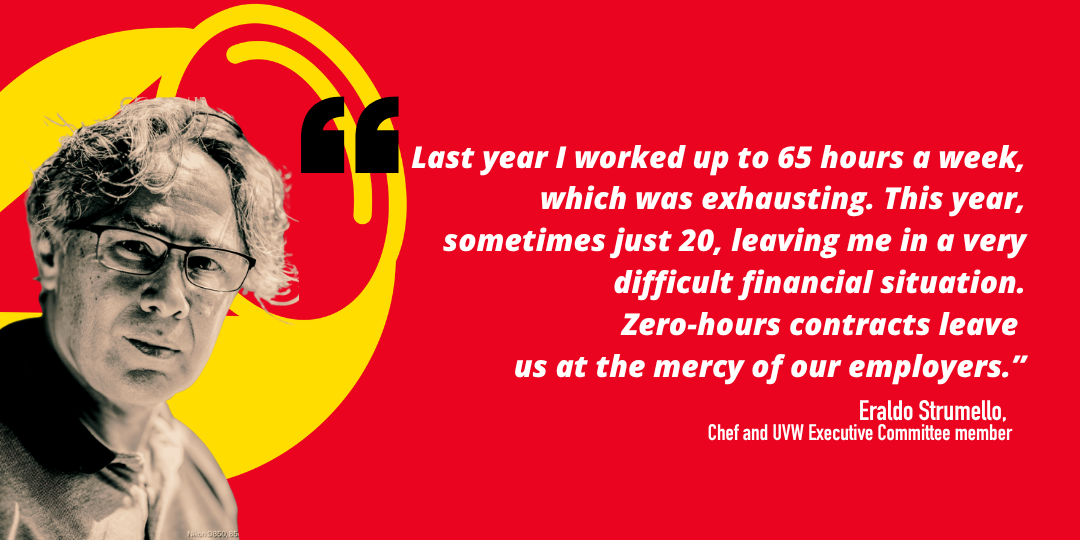
The number of people on zero-hours contracts has hit a record high with more than 1.2 million people now on them, despite government reforms aimed at cracking down on their use. For hospitality workers particularly, zero-hours contracts mean unpredictable hours, unstable incomes and being left at the mercy of employers.
Migrant hospitality workers in United Voices of the World (UVW) are speaking out as employers lobby over new legal protections due to take effect in 2027.
Zero-hours contract reforms are already part of the Employment Rights Act 2025. The Act gives qualifying workers new rights to guaranteed hours reflecting the hours they regularly work, reasonable notice of shifts and changes to those shifts, and payment when shifts are cancelled, curtailed or moved at short notice.
However, these measures have not yet taken effect. The government is currently consulting on the regulations that will determine how the new rights work in practice, with the consultation closing at 11:59pm on 25 August 2026.
Hospitality is one of the sectors where insecure and variable-hours work is particularly common. For migrant workers, the insecurity can be especially damaging.
Eraldo Strumiello, a chef working in a restaurant in central London and a UVW Executive Committee member, said:
“I work in the hospitality sector as a chef in a restaurant in central London. I think the issue of zero-hours contracts is a serious problem for all workers, reminiscent of the Industrial Revolution, especially in this country.
At that time there were no regulations and it was very common for women, men and children to work until complete exhaustion; many died while sleeping. Today, apart from child labour, the situation remains very similar for migrant workers. We are at the mercy of employers and government laws.
When employers need us to work more hours, they call us. I myself worked 55, 60 and even 65 hours a week during many periods of last year.
Generally, migrant workers have to renew their visas and deal with other bureaucratic procedures, and they are at the mercy of their bosses, so they do not refuse to work so many hours.
When there is instability in companies, they reduce our working hours, leaving us in a very difficult financial situation.”
Isabel Cortés, UVW Assistant General Secretary, said:
“Many migrant workers in hospitality are already navigating visa renewals, immigration requirements and other bureaucratic pressures while relying on poverty wages to support themselves and their families. When employers control whether workers receive enough hours to make ends meet, that imbalance of power becomes even more pronounced.
This is why migrant workers need to build strong unions, like UVW. We can’t accept a system where employers have the power to decide whether workers have enough hours to survive. By organising together, workers can challenge that power, fight for guaranteed hours and build the security, dignity and decent conditions we all deserve.”